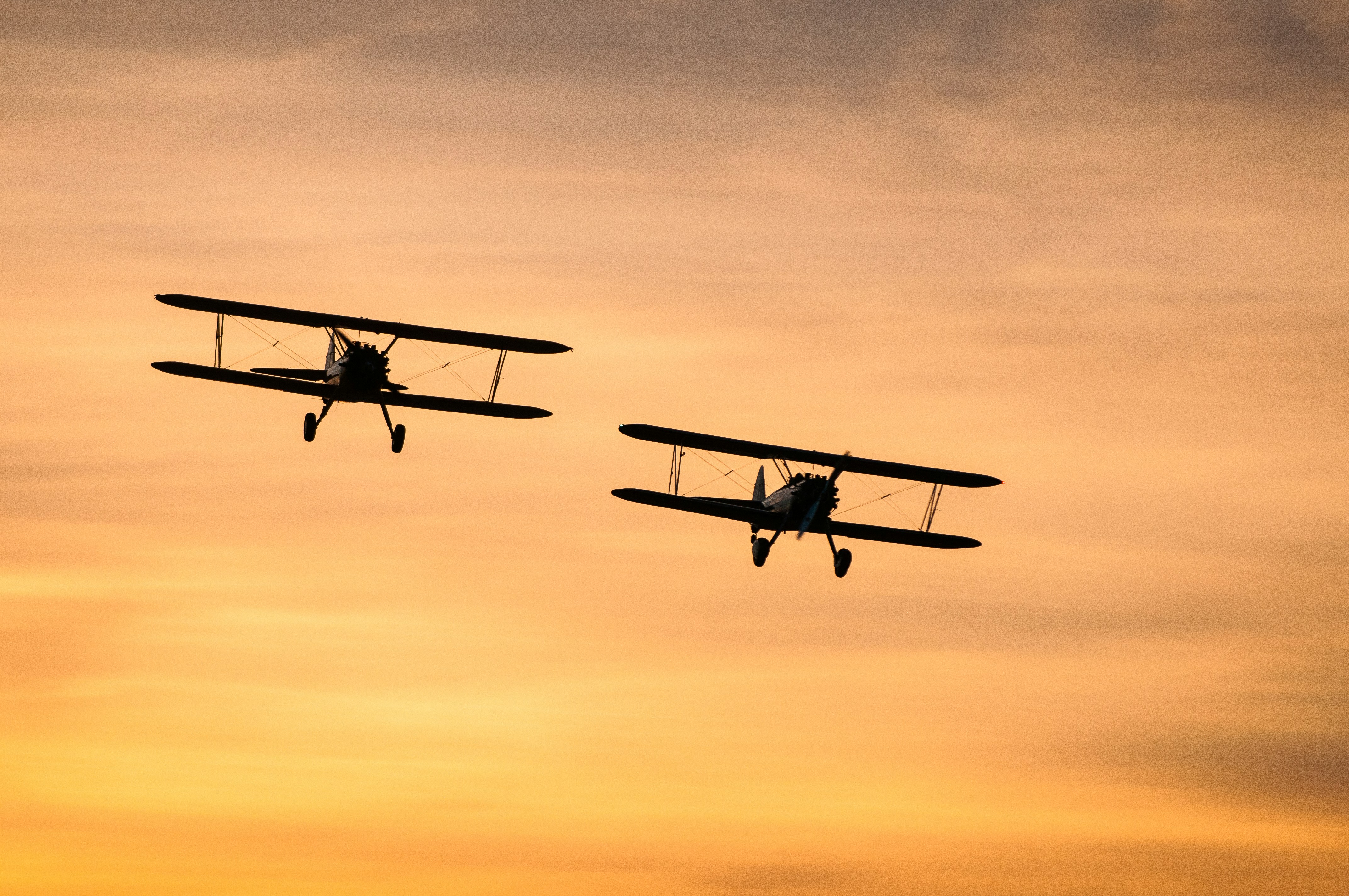
The best American air power was not born all at once in a hangar or a laboratory. It was assembled, clause by clause, from European theory, wartime practice, and an American appetite for scale.
When the United States entered the First World War in 1917, it did so with a small and largely obsolete aviation arm, while France, Britain, and Germany had already turned aircraft into weapons, machines, and systems. America’s early air effort depended on learning from that experience. The National Park Service records that developments in France and Germany transformed a fledgling industry into an important component of military operations, and that a French proposal — to expand the American air force to thousands of aircraft — became the basis for the United States’ military aviation program.
That foreign inheritance did not stop at doctrine. European designers and research traditions were folded into American aviation through imported aircraft, aerodynamics work, and technical exchange. The National Advisory Committee for Aeronautics, the body that would eventually become NASA, was itself modelled on European agencies — chiefly Britain’s Advisory Committee for Aeronautics, alongside French and German laboratories — and it maintained a presence in Paris to monitor European research at first hand. The United States was learning in public, then industrialising the lesson.
Immigrant engineers
The deepest break came with the immigrants. Igor Sikorsky, born in Kyiv when it was still part of the Russian Empire, left after the Bolshevik Revolution and reached New York in 1919; in 1923 he founded Sikorsky Aircraft, and in 1942 his R-4 became the world’s first production helicopter. Wernher von Braun, whose wartime record includes Peenemünde and the V-2 built with concentration-camp labour, surrendered to American forces in 1945 and entered U.S. service through Operation Paperclip; later, at NASA, he led the design of the Saturn V that launched Apollo 11. Their biographies are not moral shortcuts. They are reminders that American air power was often built by people whose technical formation began elsewhere — and, in von Braun’s case, that the inheritance carried a darkness that cannot be set aside.
The American system
What made those talents decisive was the American system around them. The United States did not merely import aircraft; it built institutions that could absorb, test, and mass-produce ideas at scale. That meant military procurement, university research, industrial partnerships, and a public willingness to spend. It also meant accepting that the most useful knowledge often arrived with accents, baggage, and histories that were not fully American.
By the Second World War, the result was unmistakable. The United States could field long-range bombers, a strategic air doctrine, and, eventually, the rocket infrastructure that would carry it into space. The country’s air power was no longer an imitation of Europe. But it had been formed by Europe first.
The old spruce frame of early aviation gave way to sovereign scale: factories, airfields, doctrine, and launch pads. Yet the grain still showed.
Sources
- U.S. National Park Service, "Dayton, Aviation, and the First World War," nps.gov.
- National Advisory Committee for Aeronautics (NACA), institutional history — NASA History Office; on NACA's modelling on European agencies and its Paris office.
- Encyclopædia Britannica, "Igor Sikorsky" and "Wernher von Braun."
- [Editorial note: the survey of North Atlantic aviation history and the WIPO working paper referenced in earlier drafts should be pinned to their exact titles and publication years before publication.]
Produced by the Editorial Team · European Roots, American Greatness
Special Feature Series: Transatlantic Corporate Genealogies